Can EMDR and ERP Be Used Together for OCD?

I was recently scolded in an Obsessive Compulsive Disorder (OCD) workshop for suggesting that I use Eye Movement Desensitization and Reprocessing (EMDR) to treat some of my clients who have OCD. The workshop leader pressed that EMDR should only be used for Post Traumatic Stress Disorder (PTSD). That was the day I became aware of the controversy of EMDR in the OCD treatment community. Although the EMDR community is training many therapists to use EMDR for conditions beyond PTSD eg: phobias, panic disorder, grief and even addictions, many in the OCD community frown upon using EMDR in treatment for OCD.
But what if OCD isn't the only thing you're dealing with?
Maybe you also carry painful experiences from childhood. Maybe certain relationships have left you feeling unsafe, unable to trust yourself, unable to tollerate risks and uncertainty. Maybe you understand your OCD intellectually, but some of the emotional patterns underneath it feel much harder to change.
This raises an important question: Can Exposure Response Prevention (ERP) and EMDR be used together?
The answer is more nuanced than a simple yes or no. ERP has a much stronger evidence base for OCD, while research on EMDR for OCD is still developing. However, emerging research has explored both EMDR as a treatment for OCD and the combination of EMDR and ERP with promising results.
In my practice, I use ERP to directly address OCD while, when appropriate, integrating attachment-focused EMDR and Internal Family Systems (IFS) to address original traumatic experiences that led to the onset of OCD.
What Is ERP Therapy for OCD?
ERP, is a form of Cognitive Behavioral Therapy (CBT) specifically adapted for OCD.
OCD often creates a cycle:
It begins with Intrusive thoughts, images, sensations, or fears.
This leads to anxiety or distress.
OCD causes you to engage in behavioral compulsions or avoidance which cause temporary relief.
As the cycle repeats OCD becomes stronger through negative reinforcement.
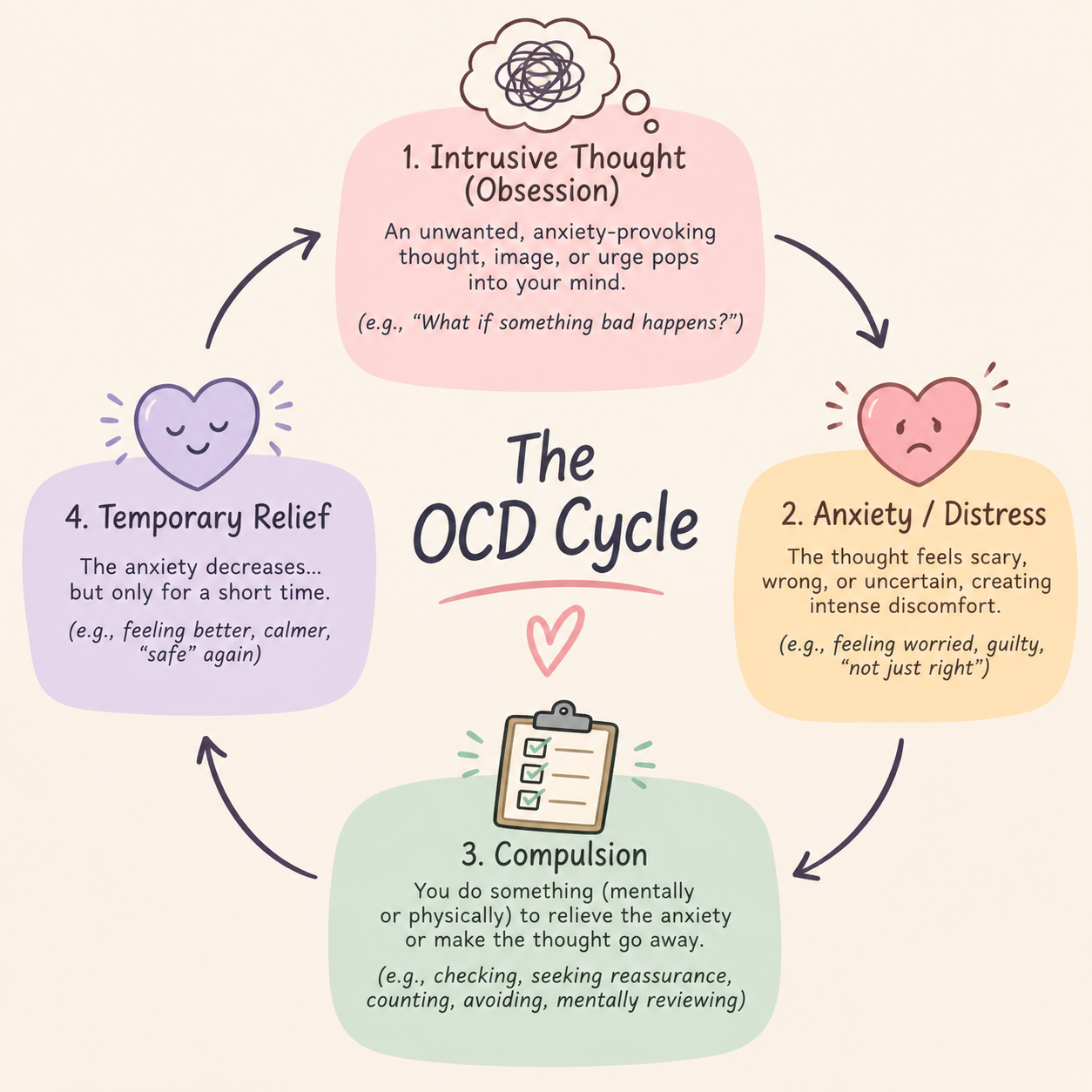
For example, someone with contamination OCD might have the thought, “What if I touched something contaminated?” The resulting anxiety may lead them to wash their hands repeatedly.
ERP helps interrupt this cycle.
During ERP, you gradually and intentionally face situations, thoughts, sensations, or uncertainties that trigger your OCD while practicing response prevention—resisting the compulsive behavior, avoidance, reassurance seeking, or other ritual.
Over time, you can learn that anxiety and uncertainty can be tolerated without performing the compulsion.
ERP isn't about getting rid of intrusive thoughts. Instead, the goal is to change your relationship with those thoughts and learn that you don't have to respond to them as though they are dangerous or require action.
What Is EMDR Therapy?
EMDR stands for Eye Movement Desensitization and Reprocessing. It is a trauma-focused therapy that was originally developed to help people process trauma and distressing experiences.
EMDR can help people become less overwhelmed by memories, emotions, body sensations, or beliefs connected to difficult experiences.
In my practice, I primarily use an Attachment-Focused approach to EMDR, which incorporates the importance of attachment, safety, consent and emotional regulation. I also integrate Internal Family Systems (IFS) and parts work as appropriate.
EMDR and ERP are two approaches that have different theories, goals, and methods.

What Does the Research Say About EMDR for OCD?
ERP has a much larger evidence base for the treatment of OCD. EMDR is not a replacement for ERP, and research examining EMDR specifically for OCD remains relatively limited.
However, there have been randomized controlled trials examining EMDR for OCD.
One 2017 randomized controlled feasibility trial compared EMDR with CBT based ERP in 55 people with OCD. Twenty-nine participants received EMDR and 26 received CBT/ERP. Overall, 61.8% of participants completed treatment, and 30.2% experienced reliable and clinically significant improvement in OCD symptoms. The researchers did not find statistically significant differences between the two groups in OCD severity after treatment or at six-month follow-up. The authors concluded that the two treatments had comparable completion rates and clinical outcomes, while emphasizing the need for further research.
This was a feasibility study with a relatively small sample, so it should not be interpreted as establishing EMDR as equivalent to ERP or as a new first-line treatment for OCD. Rather, it provides preliminary evidence that EMDR warrants further study.
There is also research specifically examining the combination of ERP and EMDR.
In a randomized controlled trial involving 60 people with OCD who had experienced stressful life events and had not responded adequately to medication, participants were assigned to either ERP plus EMDR or ERP alone. Both groups showed reductions in OCD symptoms and anxiety. The researchers reported that the combined ERP-plus-EMDR group had greater improvement and lower attrition than the ERP-only group at the end of treatment and follow-up.
These findings are interesting, but they should also be interpreted cautiously. More research is needed to determine which people with OCD are most likely to benefit from adding EMDR, what EMDR targets are most appropriate, and how the two approaches should best be integrated.
Why Might Someone With OCD Also Benefit From EMDR?
OCD does not necessarily come from trauma.
People develop OCD for many different reasons, and having OCD does not mean that you have experienced trauma.
However, some people with OCD also have a history of difficult or traumatic experiences, attachment disruptions, or other experiences that continue to affect how they see themselves and the world.
For example, someone may carry deeply held beliefs such as:
- “I have to be perfect to be safe.”
- “I can't trust myself.”
- “If I make a mistake, something terrible will happen.”
- “I am responsible for keeping everyone else safe.”
- “I can't tolerate uncertainty.”
- “Something is wrong with me.”
These beliefs aren't necessarily OCD themselves. But they may interact with the fears, vulnerabilities, and emotional patterns that OCD can exploit.
For someone with this combination of experiences, ERP may be used to address the OCD cycle, while EMDR may address underlying trauma or past highly distressing experiences that are contributing to the OCD.
How Might ERP and EMDR Work Together?
ERP and EMDR don't necessarily need to be used for the same symptoms.
ERP focuses directly on OCD.
It helps you face feared situations, thoughts, sensations, and uncertainty while learning not to perform compulsions or other safety behaviors.

EMDR focuses on processing distressing experiences and the emotional, physical, and relational responses associated with them.
For example, someone might use ERP to work with contamination fears and compulsive washing while also using attachment-focused EMDR to address an earlier experience that continues to contribute to feelings of being unsafe, defective, responsible, or unable to cope.
The two approaches can therefore address different layers of a person's experience.
Treatment doesn't necessarily mean doing both therapies in every session. Depending on the person, therapy might involve periods of focused ERP, preparation and resourcing, trauma or attachment-focused EMDR, parts work, or integration.
The treatment plan should be individualized.
What If ERP Feels Extremely Difficult?
ERP can be challenging.
Facing something that OCD has taught you to fear—and then resisting the behavior that normally provides temporary relief—can understandably feel uncomfortable.
A skilled ERP therapist will work collaboratively with you to develop exposures that are appropriate for your particular OCD symptoms and treatment goals.
If you also have trauma or significant emotional distress, those experiences may affect how you experience ERP. In some cases EMDR can help reduce the emotional charge of the traumatic memories, freeing you up to be able to tollerate ERP better.
Sometimes therapy needs to also include IFS work to help you develop greater emotional regulation, self-compassion, and capacity to tolerate difficult emotions alongside ERP.
Is EMDR for OCD Controversial?
Yes. There is legitimate debate within the OCD treatment community about the use of EMDR specifically for OCD.
That debate is important because ERP has a strong evidence base and should not be displaced by less-established approaches when ERP is indicated.
However, the randomized studies described above suggest that EMDR—and potentially the combination of EMDR and ERP—deserves further investigation.
My approach is not to present EMDR as a substitute for ERP.
Instead, when I believe it is appropriate, I integrate Attachment-Focused EMDR with ERP and other approaches based on the individual person's needs.
An Individualized Approach to OCD Treatment
For some people, OCD is the primary concern and ERP may be the central focus of treatment.
For others, OCD exists alongside trauma or painful experiences that also deserve attention.
Treatment must be tailored to each person's individual needs.
ERP can help you change the patterns that maintain OCD.
Attachment-Focused EMDR and IFS may provide another way of working with painful experiences, emotional patterns, and beliefs that are also affecting your life.

The goal isn't to use as many techniques as possible. The goal is to understand what is maintaining your difficulties and choose interventions that are appropriate for you.
If you are considering therapy for OCD, you don't need to determine on your own whether you need ERP, EMDR, or another approach. A thorough assessment can help clarify what you're experiencing and what kind of treatment may be appropriate.
If you would like to explore whether therapy might be helpful, I offer a free 15-minute phone consultation to discuss your concerns and determine whether we might be a good fit.
I work with adults and adolescents experiencing OCD, anxiety, trauma, and related concerns. My approach integrates ERP, CBT, EMDR, and IFS/parts work when appropriate to the individual.

Chiara Manodori, LCSW
Trauma-informed therapist specializing in helping adults and adolescents navigate trauma, eating disorders, OCD and related mental health concerns through effective evidence-based approaches.